Rickrolled While Researching
This week, we learned about Collective Intelligence and Digital Authorship, and the article that stood out to me the most was UXMyths. The Myth noted was "people read on the web." The article, although brief, contained several links. I was able to access two of the links from Slate, but I was blocked from the Washington Post article by a paywall. I read Slate for pleasure, so I was able to make it through both articles, "Lazy Eyes" and "You Won't Finish This Article." It was at the end of "Lazy Eyes" that I clicked the last link and was Rickrolled.
Video is of Rick Astley singing Never Gonna Give You Up.
I did finish the article "You Won't Finish This Article ", along with at least the seventy-nine other people who commented on it. This article provided information about scrolling habits and how far into a web article most people typically scroll. The information used in the article was provided by the traffic analysis firm Chartbeat. The article includes statistics on the average article length, which is approximately 2000 pixels long. About fifty percent of people only make it to the 1000th pixel in Slate articles. They also note that a typical browser window is 700 pixels tall. The histograms provided by Chartbeat show that a large percentage of people don't scroll at all. It also shows that most visitors see all the content in video and photos. Some of that can be attributed to the way Slate lays out each page. This article didn't offer much guidance on improving readability, unlike the other article. It was, in the end, mostly a lament on our cultural lot: "We live in the age of skimming." Even the writer, when reading, doesn't finish that many articles.
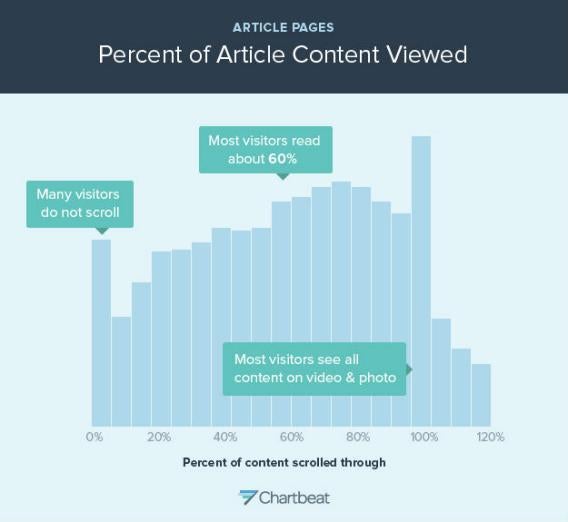
Graph of the percent of article content viewed. Many visitors do not scroll, most visitors read about 60% and most visitors see all content on video & photo.
"Lazy Eyes" was an investigation into how we read online, utilizing usability expert Jakob Nielsen's research. Some of the quotes attributed to Nielsen are " users are selfish, lazy, and ruthless," "a good editor should be able to cut 40 percent of the word count while removing only 30 percent of the article's value," and "embrace hypertext. Keep things short for the masses, but offer links for the Type A's." I found this writing to be hyperbolic and clicked a link in their article to a 1997 article by Nielsen. This article was also the first link in the UXMyth article. Nielsen found that 79% of their test users scanned any new page, and only 16% read it word by word. The article provided tips on how to enhance the usability of websites by making them concise, with one idea per paragraph, scannable, and highlighting key points with objective language.
Although the main study for the UXMyth article and "Lazy Eyes" was conducted in 1997, I believe the primary finding — that people are not reading websites — still holds today, possibly at an even higher percentage. I'm not sure that "objective language" has the same credibility in today's world. However, making an article concise, scannable, and adding links to other sites are tips that still help in most online writing.


Comments
Post a Comment